[ad_1]
UNDERSTANDING THE SEEMINGLY OPPOSITE SUPREME COURT FTC FIRING AND FED “NO FIRING” DECISIONS
by Anne P. Mitchell, Esq. – attorney and law professor emeritus – giving you 100% facts and truth in plain English about what’s going on with this administration and the law
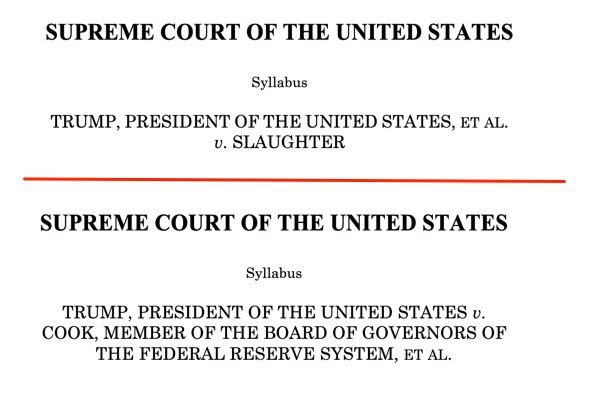
You would be forgiven if you are confused by the seemingly opposite twin decisions that the Supreme Court handed down today regarding a president’s right to fire whomever the heck he wants.
You would also be forgiven if you are wondering just who the heck is Humphrey, and why should we care about his executor?
Let’s start with the last first: Humphrey’s Executor is the 1935 Supreme Court decision that unanimously upheld the restriction on a president being able to fire an FTC commissioner unless it was “for cause”, as codified in the Federal Trade Commission Act of 1914. FDR had fired William Humphrey over disagreements between the two, not “for cause” (spelled out in the FTC Act as “inefficiency, neglect of duty, or malfeasance in office”). Humphrey sued, and by the time it wended its way through the courts Humprey had died, leaving the executor of Humphrey’s estate to stand in his stead as the plaintiff.
Many legal scholars and judges have had the opinion, for the near 100 years since Humphrey’s was decided, that it was incorrectly decided, despite that it was a unanimous decision back in 1935. Some point to the fact that Congress gets to have their say when they choose to either confirm or not a president’s nominee, and that after that the person should be able to be fired by the president. Others point out that the executive branch, well, it’s right in the name – it’s an executive set up, with the president as the CEO, and everyone in his executive agencies as employees, so why wouldn’t the president have the power to fire someone for whatever reason, or no reason at all?
Still others say, indeed as does Justice Roberts in today’s Slaughter decision. that it makes no sense to force a president to work with someone with whom, in fact, he cannot work. Said Roberts in today’s opinion, “Although it is up to the Senate to decide whether to confirm those with whom the President would prefer to work, neither Congress nor the courts may saddle him with those with whom he cannot work.”
In fact, Roberts has been gunning for Humphrey’s ever since at least 2010, with the first attack in a case called Free Enterprise Fund v. PCAOB.
That’s right – Justice Roberts has been chipping away at Humphrey’s for more than 15 years. And today he put the final nail in the coffin, and openly says as much when he says:
“If anything more is left of Humphrey’s, the Court overrules it.”
And that death knell for Humphrey’s means that Trump did not have to prove “cause” in order to fire FTC Commissioner Rebecca Slaughter. He actually fired both Slaughter and Alvaro Bedoya – the two Democrats that Trump inherited when he took office in 2025. He didn’t say why he was removing them, other than that their continued service was “inconsistent” with his administration’s priorities.
The bottom line is that the Slaughter case stands for the president being able to fire people who work at his executive agencies. This basically removed the teeth – with respect to this one issue – from dozens of Federal laws relating to the firing of federal employees at various executive agencies.
So then why did the companion case of Federal Reserve Governor Lisa Cook have such a different outcome?
Well, you see, it didn’t, really. Well, it did and it didn’t.
The Supreme Court bent so far over backwards to justify *not* letting Trump fire Cook that circus contortionists are jealous.
The Supremes point to the Federal Reserve Act’s requirement of “for cause”. (Of course all of the “for cause” requirements in all of the laws and regulations that had just been tossed with the Slaughter case, well never mind that.)
Then they talk a lot about the long history of the Fed being independent. Never mind that in Slaughter Justice Gorsuch gleefully observes that “independent agencies are not so independent after all”. (As I mentioned in this morning’s livestream, colleagues will be either delighted or traumatized at the mention of McCullough v. Maryland which, I suspect, many of us had put behind us after our first year of law school.)
So, what *does* account for the seeming opposite (but not really) holdings?
It’s very important to remember that Trump attempted to fire Cook because she had allegedly committed mortgage fraud. Technically he had asserted a “cause”. So this one is *not* a case of trying to justify a firing without cause.
HOWEVER that fraud was never proven – so the “cause” was never validated.
In fact, found the Supremes, Cook had never had an opportunity to present any evidence that would clear her name.
So in Cook the case has been remanded (sent back) to the lower court for more legal wranglings.
Hopefully that helps to clear up at least some of the confusion.
Notes from the Front members: both the Slaughter and Cook opinions are in your inbox now.
If you’re not a Notes from the Front member yet, please consider joining us! It’s just $5 a month and not only will you be supporting my research and reporting for you – and my coffee habit – but you will have access to all of the documents, to our live shows, and to our members-only chat! You can join here and of course you can cancel any time!
https://annepmitchell.substack.com/subscribe
New by popular demand: Many of you have asked how you can support my work without joining Notes from the Front (thank you for asking! ❤️), here’s how: https://www.annepmitchell.com/buy-anne-a-coffee/
P.S. If you actually read all the way to the bottom please leave a comment that includes the word “FDR”. It will show me that my efforts aren’t in vain and that people actually *do* read these things, and it will drive those who just skim crazy wondering just why everyone is talking about President Roosevelt! ;~)
[ad_2]
Source