
NO! THE VOTING RIGHTS CASE WAS *NOT* DECIDED BASED ON “FALSIFIED” INFORMATION. BUT IT WAS DECIDED BASED ON SLIMY MANIPULATION OF THE DATA!
You’re going to see a lot of social media claims that “The Supreme Court voting rights case was based on falsified data.” That is not true. HOWEVER, it *was* based on data submitted to the Court by the administration in their Amicus brief which used a data methodology designed to mislead the Court into believing that black voter turnout had exceeded white voter turnout, and so that there was no longer a need for the §2 protection of a presumption of racial bias in how a district was drawn.
(As a reminder, that Supreme Court opinion made it so now you have to *prove* racial bias rather than allege it – which is why I have said that I believe that, under the new, stricter rule, attorneys will be turning to alleging pretext).
An Amicus brief, by the way, is also known as a ‘Friend of the Court’ brief – it’s a document supporting one side or the other, containing legal arguments submitted to the Court by someone who is not a party to the case but who has a vested interest in the case. One has to apply to be allowed to submit an Amicus brief to the Court.
First, note that in both the Amicus brief and the opinion, voter “turnout” and “participation” is being *inferred* by census data – obviously there aren’t people at the polls counting how many blacks and how many whites are going in to vote.
So here’s what the DOJ did, put in simple terms: in their Amicus brief (included for Notes from the Front members) they asserted that “Since 2004, black voters have turned out at higher rates than white voters in two of five presidential elections nationwide and in Louisiana. ”
And in the opinion Justice Alito leaned heavily into that, saying:
“Black voters now participate in elections at similar rates as the rest of the electorate, even turning out at higher rates than white voters in two of the five most recent Presidential elections nationwide and in Louisiana.”
Now, that is not false.. *if* you are looking at total number of black adults over the age of 18.
But what the DOJ *didn’t* do was *subtract* the number of black adults who were *ineligible* to vote! So black adults over the age of 18 who were incarcerated, who have a felony conviction and are still on probation or parole, or who hadn’t registered to vote, or *who don’t even have citizenship*!
So one method simply looks at the total black population over the age of 18. The other method, which is generally accepted by experts to be the *preferred* method, looks at a total black population over the age of 18 *minus* those who are ineligible to vote. The former is sometimes referred to as “total voting age population” and the latter “voter eligible population”; the method that looks specifically at eligibility based on *citizenship* is called “citizen voting age population”.
According to the Guardian, “A justice department spokesperson acknowledged that the agency used total voting age population and not the citizen voting age population to compute turnout figures.”
Using the broader “total voting age population”, the number do indeed bear out Justice Alito’s conclusion. But using the generally accepted method, “voter eligible population” or at least “citizen voting age population” (CVAP) the numbers tell a much different story.
Using the method that the DOJ submitted in their Amicus brief, total voting age population, it shows that inferred black voter turnout was .1% higher than white voter turnout (60.9% as compared to 60.8%)
Using the more generally accepted CVAP, however, shows that the *actual* *eligible* black voter population is 61.3% as compared to 62.4%.
Now, 1.3% may not seem like much, but it is statistically significant.
And more to the point, it reveals the DOJ’s weasely ways.
Said Professor Michael McDonald, a leading expert on voter turnout, “If I wanted to manipulate the numbers in a way that was favorable to the government’s interest, I would be using voting age population,” adding that “Someone knew what they were doing.”
So, what can be done about this?
Well, the original plaintiffs in the case can file a Rule 44 petition with the Supreme Court (so called because it is the 44th of the Supreme Court Rules). This is a petition for rehearing, and is very rarely granted, and only under very narrow circumstances; the Court may or may not deem this situation to meet its bar for a Rule 44 rehearing. The Rule 44 petition must be filed within 25 days of the date that the Supreme Court decision was handed down, practically speaking that means by Friday, May 22nd.
Or the original plaintiffs or *other* parties can start a new lawsuit against the administration.
Or both.
The thing is, now that this has come to light, it may be that the Supremes may believe that the difference between .1% and 1.3% isn’t enough to make a difference.
It will be incumbent on whomever challenges it to convince them that it’s a difference that really is a difference.
As of the writing of this article, I am unaware of anyone preparing a Rule 44 petition or a lawsuit, but I’d bet that someone is.
Notes from the Front members: The government’s Amicus brief, if not a smoking gun at least a warm gun, is in your inbox now!
If you’re not yet a Notes from the Front member, stop relying on this platform’s algorithms to show you my updates! Never miss a single one of my legal or Epstein updates by getting them right in your inbox (no ads, no spam, just legal and Epstein updates)!
You can join right now at this link, get the documents, and help keep me in coffee to continue my reporting! It also gives you access to all the documents and our private chat! And yes, really, your $5 a month helps support my coffee habit and helps me keep on with all of the research and writing I’m doing from the front. Join now here for instant access:
https://annepmitchell.substack.com/p/no-the-voting-rights-case-was-not
Not ready to commit? You can also ensure that you never miss an update by getting them directly in your inbox for *free* (yes really) by signing up for my Notes from the Front Lite – it’s like Notes from the Front but without the documents and private chats. You can sign up for that here (it really is completely free, no ads, no spam, just also no documents or private chats): https://notesfromthefront.fyi
New by popular demand: Many of you have asked how you can support my work without subscribing to my $5 Substack (thank you for asking! ❤️), here’s how: https://www.annepmitchell.com/buy-anne-a-coffee/
P.S. If you actually read all the way to the bottom please leave a comment that includes the word “weasely”. It will show me that my efforts aren’t in vain and that people actually *do* read these things, and it will drive those who just skim crazy wondering why everyone is talking about something weasels! ;~)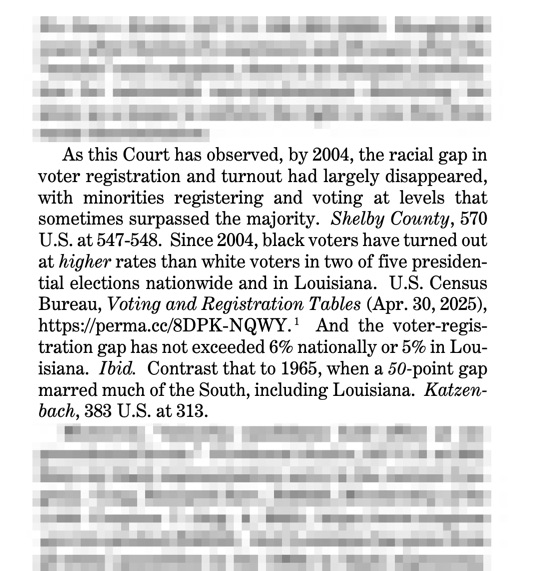
Source