[ad_1]
ABOUT TODAY’S SUPREME COURT (IN)ACTION IN THE ARKANSAS VOTING RIGHTS CASE
by Anne P. Mitchell, Esq. – zero hyperbole and 100% facts in plain English about what’s going on with this administration and the law
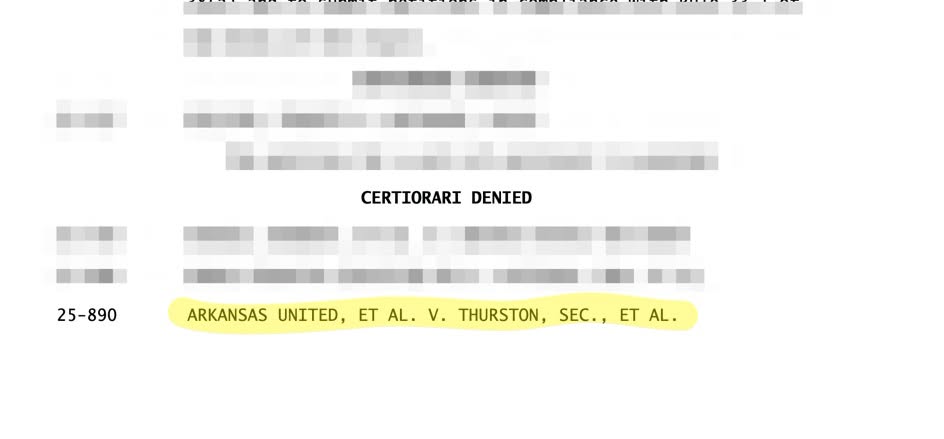
You may have heard about an action that the Supreme Court took today regarding the Voting Rights Act. I say “action” very specifically, because it wasn’t a decision, and it wasn’t even really an action. They denied cert (certiorari). As a reminder, that’s a fancy legal way of saying “we decline to review the lower court’s decision”. It is *not* a decision on the merits of the case, it is not a decision on the administrative posture of the case, in fact it’s *not a decision at all*. It’s basically a non-decision or, if you will, a “we’re basically ignoring this case”.
Why? Who knows why. The Court can deny cert for any reason or, indeed, for no reason at all. It’s their prerogative.
In this case it’s a big deal because of what we in the law call the “procedural posture” of the case, in other words the current status in terms of orders, opinions, the parties, etc.. So let’s start at the beginning.
A social agency, Arkansas United (AU), and an individual, L. Mireya Reith, were suing various officials in the state of Arkansas for a violation of the Voting Rights Act (VRA), specifically section 208 (§208), which provides that voters who require assistance because of a disability are entitled to have an assistant of the voter’s choice (so long as it is not their employer or an agent of their union – as that would invite too much undue influence).
The state of Arkansas enacted a law saying that any given person who was assisting disabled voters could assist no more than 6 voters in any given election. Specifically it says that “no person other than an election official shall assist more than six (6) voters in marking and casting a ballot at an election.”
AU and Reith sued saying that by Arkansas putting a limit on how many disabled voters an individual can assist, Arkansas’ law violated §208. Keep in mind that §208 is *silent* on how many voters a single individual can assist. It doesn’t say that a state can’t limit it, and it doesn’t say that a state can limit it. Again, it’s silent.
The trial court, the District Court for the Western District of Arkansas, found for AU and Reith, and, in fact, ordered summary judgement in their favour. Arkansas appealed saying, and this is important, that AU and Reith did not have standing to sue in the first place because the Voting Rights Act does *not* include a private right of action – in other words within the text of the Voting Right Act there is nothing conferring a right for a private individual to sue. There’s also nothing denying that right. Here too, the law is *silent*.
The 8th Circuit agreed with Arkansas (Notes from the Front the 8th Circuit opinion and order is in your inbox now), saying, among other things, that Congress was careful to say who *could* sue (the U.S. Attorney), and because they made a point of saying who *could* sue, that their *omitting* a private right of action was intentional – put another way, if Congress had wanted private individuals to sue under §208 of the VRA they would have said so right in the law.
Remember that while the Voting Rights Act is a federal law, it is the *states* who run federal and state elections. So generally it is an individual suing their state *under* the Voting Rights Act. Here the 8th Circuit basically said that only the Attorney General can enforce §208 of the federal VRA against a naughty state, because that’s who is mentioned in the law.
(You can think of it as sort of similar to someone *not* being listed as a beneficiary in a will, when other people are listed as beneficiaries in the will. Clearly the person making the will listed who they wanted, so if you’re not listed it was intentional.)
Then the 8th Circuit remanded the case to the District Court, ordering the District Court to reverse its order, making AU and Reith the losers and the state of Arkansas the winners.
The District Court did so, and issued a final judgement in the state’s favour on January 14th of this year (Also included for Notes from the Front members). The request for cert was filed with the Supreme Court on January 22nd of this year.
Today the Supreme Court denied cert, “letting” the 8th Circuit’s decision and reasoning stand.
Ok, now you’re up to speed on the procedural stuff.
So what does it all mean?
Well first, with respect to the immediate practical effect of the underlying case itself, it means that if you are in one of the states covered by the 8th Circuit (Arkansas, Iowa, Minnesota, Missouri, Nebraska, North Dakota, and South Dakota) and *only* in one of those states – that you can’t, at this point in time, sue under §208 of the VRA as an individual. And if you are in Arkansas it means that you can’t assist more than 6 disabled voters in any given election.
And as you may have inferred from that last paragraph, it also means that *other* Circuit Courts (Courts of Appeals) may decide the same question, if it comes up, very differently.
And that may the reason, or one of the reasons, that the Supreme Court denied cert. If another Circuit comes out differently, saying that the VRA has, for example, an implicit private right of action, that may be a riper time for the Supremes to wade in and weigh in.
Moreover, there is a federal law known fondly as “Section 1983”, and more formally as “42 U.S. Code § 1983 – Civil action for deprivation of rights” which basically provides a *blanket private right of action* to individuals whose constitutional or other legal rights (such as spelled out in a federal law – like the VRA) have been violated by a state (such as Reith argued is the case with Arkansas’ six-assist limit).
Meaning there is still at least one way for individuals to sue for violations of §208.
Of course, the ideal thing would be for us to flip Congress in November, and have the VRA amended to specifically include a private right of action.
On a related note, this is one of the reasons that increasingly states are passing their own Voting Rights Acts (8 states so far).
Notes from the Front members: both orders are in your inbox now for you to read.
If you’re not a Notes from the Front member yet, please consider joining us! It’s just $5 a month and not only will you be supporting my research and reporting for you, but you will have access to all of the documents, to our live shows, and to our *private* members-only chat! You can join at this link and of course you can cancel any time!
https://annepmitchell.substack.com/p/about-todays-supreme-court-inaction
New by popular demand: Many of you have asked how you can support my work without joining Notes from the Front (thank you for asking! ❤️), here’s how: https://www.annepmitchell.com/buy-anne-a-coffee/
P.S. If you actually read all the way to the bottom please leave a comment that includes the word “posture”. It will show me that my efforts aren’t in vain and that people actually *do* read these things, and it will drive those who just skim crazy wondering just why everyone is talking about their posture! ;~)
[ad_2]
Source