
YES!! SUPREME COURT 9-0 SAYS INTERNET PROVIDERS NOT RESPONSIBLE FOR THEIR USERS’ MISDEEDS
Yay! I get to report on a case that draws on my background as an Internet law and policy attorney! The Supreme Court *just* issued its opinion in the Cox (the Internet provider) case. And it’s a beaut! And, again, a *9-0* decision!! (Included for Notes from the Front members.)
First, for nearly *30 years*, ever since the passage of the DMCA (Digital Millennium Copyright Act) way back in *1998*, it has been the case that Internet providers have what is known as a “safe harbor” when it comes to their users violating copyright. Basically, so long as they do something about the copyright-violating user once it’s brought to their attention, the Internet provider can’t be held legally liable for the acts of that user.
For example, if, while logged in to their Cox Internet services, one of Cox’ customers – let’s call him Fred – downloads a pirated version of a song, Cox is *not* legally responsible for that. Now, if it is brought to Cox’ attention that Fred was using Cox’ services to illegally download that song, and if Cox does nothing about it, now Cox has knowledge and is *allowing* it.
(Fun fact: This is very similar to the Federal law that I wrote having to do with merchants who have affiliates and whose affiliate advertise the merchant through spam. If the merchant doesn’t know that their affiliates are spamming, well, they don’t know. But once it is brought to their attention that the affiliate is advertising the merchant through spam then that merchant is on the hook for the spam *as if the merchant themselves hit ‘send’ on that spam*!)
Anyways, the DMCA has always provided this safe harbor for Internet providers, such as Cox, since 1998.
Well, Sony, Warner Music Group, Universal Music Group, and several other labels don’t like this. So they sued Cox saying that because, when they notified Cox of infringing behaviour on the part of Cox’ users, Cox didn’t hop to it to their satisfaction, that Cox was a) contributorily liable (meaning they were affirmatively contributing to the infringement), and/or b) vicariously liable (meaning they benefited from it even though they were just passively contributing to it). Isn’t it cool how in the law you can argue X and/or Y? :~)
Well, the lower court clearly was not well-versed in Internet law and policy, because the lower court found for Sony on both theories.
Cox appealed to the Fourth Circuit appellate court who partly agreed with Cox and partly with Sony, using a products infringement precedent that concluded that “supplying a product with knowledge that the recipient will use it to infringe copyrights is exactly the sort of culpable conduct sufficient for contributory infringement.”
The Supreme Court directly and roundly admonished the Fourth Circuit, saying that they got it wrong, wrong, wrong, because a) this case had only one of the elements of the precedent on which the Circuit court had relied, and not two other required elements, and in any event b) the Circuit court’s decision “also conflicted with this Court’s repeated admonition that contributory liability cannot rest only on a provider’s knowledge of infringement and insufficient action to prevent it.”
And then in that beautiful 9-0 decision the Supreme Court said “Internet providers, we’ve got your back.”
Notes from the Front members: The brand-spanking new Supreme Court decision is in your inbox now.
Not a Notes from the Front member and want to read the documents that are included with my articles? You can find them on the Internet (except when you can’t), or you can get them directly in your inbox every time by joining us for just $5 a month. I do all the searching and research so that you don’t have to! Plus by becoming a member you get access to our private chat (so many great people in that chat!), and the all-documents archive. Join now at the link below, which will also give you immediate access to any document included with this here article:
https://annepmitchell.substack.com/p/yes-supreme-court-9-0-says-internet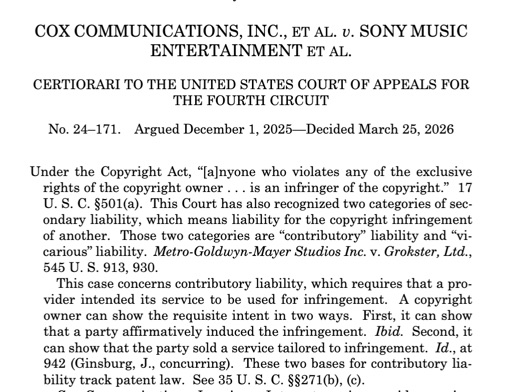
Source