YES!! COURT PROTECTS ENDANGERED SPECIES ACT 🐆🐟🦤
(Remember I promised you that I would *not* do any April Fools pranks, this is a real case and outcome.)
In a case that has been going on since Trump I, when he first revealed his true colours with respect to his complete and utter lack of regard for our wildlife and our environment, the Court *just* handed him his bass (and a bunch of other protected species).
This is *vastly* simplified, but it gets you there: This case stems from the Endangered Species Act (ESA) and the National Environmental Policy Act (NEPA). Under ESA, specifically sections 4 and 7, the defendants (including U.S. Fish and Wildlife, the National Marine Fisheries, and eventually the Department of the Interior, collectively referred to in the opinion as “the Services”) must maintain a list of threatened and endangered species and their critical habitats (Section 4), and other federal agencies are required to consult with the Services before taking actions that may impact the species on that list (Section 7).
Under NEPA various agencies need to, among other things, determine whether they need to file an Environmental Impact Statement (ESA) or its less-stringent cousin the Environmental Assessment (ES) or, by contrast, determine that a Categorical Exclusion (CE) is appropriate, meaning that neither an ESA or ES is required. They are required to cross-check what they are doing against the Section 4 list, and to consult with the Services under Section 7.
It may seem just a small bit of law, but this bit of law *protects our endangered species*, *protects their habitats*, and *protects our environment*.
While the details are complicated and get into a lot of minutiae, the gist of it is that during Trump I, Trump issued an Executive Order that ordered agencies to get rid of “unnecessary regulatory burdens”, and as result, some of those “unnecessary regulatory burdens” that were monkeyed with included sections 4 and 7 of the ESA.
Now, if you read the opinion and order (which I highly recommend), you’re going to come across the term “vacatur”. That’s legalese for “as if it never happened”. In other words, if a Court applies vacatur to a prior order or judgement of the Court, it’s as if that prior order or judgement never happened – it vacates it, or voids it.
The plaintiffs in this case wanted vacatur of those new agency regulations that were messing with sections 4 and 7. But the Court – and this was now into the Biden administration – allowed the defendants (“the Services”) to do their own remedial corrections to the offending regulations.
That got them part of the way – but not all of the way – there.
In the meantime Trump II happened, with another EO to further mess with agency rule-making.
Ultimately Section 7 was modified to, among other things, make it more difficult for the Services to get involved in reviewing a planned project. That modification included that in order for the Services to be able to review and suggest alternatives for a project to avoid harm under ESA, the harm had to be “reasonably certain to occur”.
This, the plaintiffs pointed out, is not only contrary to ESA’s requirement that the agencies use “the best scientific data available” when reviewing a project for harm and suggesting less harmful alternatives, but it is also contrary to ESA’s language that the jeopardy be “likely”. “Reasonably certain” is a higher burden to meet than “likely”.
In addition, the Services are required to evaluate and render an opinion on the “effects of the action” (the project). Before the Trump I change, that meant “the direct and indirect effects of an action on the species or critical habitat, together with the effects of other activities that are interrelated or interdependent with that action.” After the Trump I change it had been amended to mean “all consequences to listed species or critical habitat that are caused by the proposed action, including the consequences of other activities that are caused by the proposed action” AND that “a consequence is caused by the proposed action if it
would not occur but for the proposed action and it is reasonably certain to occur.”
See, there’s that “reasonably certain to occur” language.
Also, before Trump I, the regulations said that the Services had to take “destruction or adverse modification” into account, which meant a “direct or indirect alteration that appreciably diminishes the value of critical habitat for the conservation of a listed species.” After Trump I “destruction or adverse modification” was changed to mean “a direct or indirect alteration that appreciably diminishes the value of critical habitat AS A WHOLE for the conservation of a listed species.”
Now, as I said at the outset, the details are complex, and you’d be forgiven if your eyes have glazed over. So here’s the bottom line:
The Court rolled these back to the pre-Trump definitions, along with a couple of other provisions that had been changed pursuant to Trump I and Trump II, and it’s a win for the animals and the environment.
Notes from the Front members: the opinion and order are in your inbox now!
Not a Notes from the Front member? Join us now to access this and all of our resources. Don’t want the documents? You can still join to support my efforts to keep you informed. :~) In fact you’ll never miss any of my posts as they will land directly in your inbox! It’s just $5 a month (or $50 a year), and I do all the research so you don’t have to. Join here to get immediate access to our private community chat, the documents, and more:
https://annepmitchell.substack.com/p/yes-court-protects-endangered-species
P.S. If you actually read all the way to the bottom please leave a comment that includes the word “bass”. It will show me that my efforts aren’t in vain and that people actually *do* read these things, and it will drive those who just skim crazy wondering why everyone is talking about bass! ;~)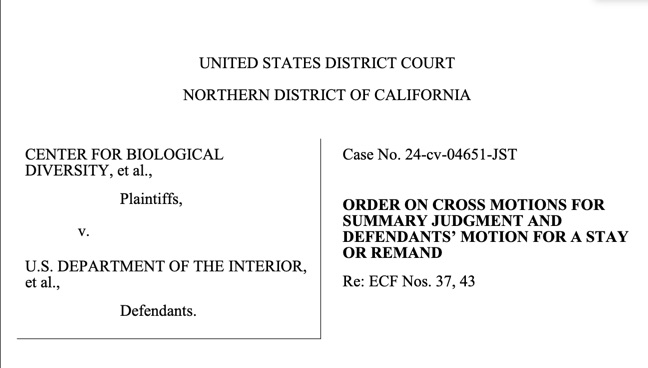
Source