
NO!!! STOP IT!! THE DOJ ATTORNEY’S ‘OOPSIE’ LETTER IN THE AFRICAN COMMUNITIES CASE DOES NOT MEAN THAT ALL THE PRIOR ARRESTS WERE ILLEGAL!
There has been a *lot* of misinformation going around about the “oops, we screwed up” letter that the DOJ U.S. Attorney for the Southern District of New York sent to the judge this week in the African Communities v. Lyons case. The worst misinformation, by far, is that “it means that all arrests outside immigration courts for the past year are invalidated”. JUST NOT TRUE!
I’m going to give it to you straight. From me – an attorney with whom the buck stops here – not some anonymous account, usually (not always, but usually) being controlled by *non-lawyers*, whose primary purposes is to whip people into a frenzy and generate shares and clicks.
In August of last year the plaintiff African Communities Together (ACT) filed a lawsuit against ICE and DHS challenging ICE’s civil arrests outside immigration courts.
There are 5 documents associated with this brouhaha, and I am including all 5 for Notes from the Front members.
Both in their court filings, and in oral argument, the government had relied on and maintained that the May 27, 2025, “Civil Immigration Enforcement Actions in or Near Courthouses” guidance issued by ICE director Todd Lyons, supported civil immigration arrests near immigration courthouses as well as other courthouses.
Now, I’ve pored over that guidance letter (included for Notes from the Front members), and it says a lot of interesting things, including that “enforcement activities in or near courthouses are often required when jurisdictions refuse to cooperate with ICE, including when such jurisdictions refuse to honor immigration detainers and transfer aliens directly to ICE custody.”
What it *doesn’t* say is anything one way or the other about arrests at immigration courts. The closest it comes to saying anything like that is this: “ICE officers and agents should generally avoid enforcement actions in or near courthouses, or areas within courthouses that are wholly dedicated to non-criminal proceedings (e.g., family court, small claims court).”
So on Tuesday of this week the U.S. Attorney working the African Communities case sent a letter to the judge in the case, Judge Kevin Castel, saying, in essence, “Oops, we said that the May 2025 guidance says we can make civil arrests in immigration court, but it doesn’t actually say that.” Now, what the U.S. Attorney’s letter *actually* says, in part (full letter included for Notes from the Front members), is:
“We write respectfully and regrettably to correct a material mistaken statement of fact that the Government made to the Court and Plaintiffs. Specifically, this morning, counsel from U.S. Immigration and Customs Enforcement (“ICE”) informed the undersigned of the following: the memorandum entitled Civil Immigration Enforcement Actions in or Near Courthouses, dated May 27, 2025 – which the Government relied on in presenting its arguments in this case and referred to as the “2025 ICE Guidance” – does not and has never applied to civil immigration enforcement actions in or near Executive Office for Immigration Review (“EOIR”) immigration courts.”
While Plaintiffs’ attorneys seized on this and called it a stunning revelation, here’s what I find equally stunning:
As I said, that 2025 guidance doesn’t say *anything* about civil arrests at immigration courts. Doesn’t say they can do them. Doesn’t say that they can’t. It says *nothing*. It is *silent* about civil arrests at immigration courts. So I actually have no idea why the U.S. Attorney went a step further and said that it *doesn’t* apply.
Not only that, but the email to which the U.S. Attorney alluded in his letter, and included as an attachment, that had been sent out to all Enforcement and Removal Operations (ERO) personnel on March 19th, 2026 (so the week previous to the U.S. Attorney’s letter to Judge Castel), *specifically says* “On May 27, 2025, Senior Official Performing the Duties of the Director Todd M. Lyons issued ICE Memorandum, Civil Immigration Enforcement Actions In or Near Courthouses. This Guidance outlines the responsibilities of ICE officers and agents in conducting civil immigration enforcement actions in or near Courthouses OTHER THAN immigration courts.” (This email is included for Notes from the Front members)
Again, I’m not sure why the U.S. Attorney and the ERO are saying that; I can only guess that whatever communication the U.S. Attorney received from ICE, and that the ERO Directors received from… someone… said that, and that for some reason legal counsel determined that this was the best legal strategy. I’m sure that it will all come out eventually.
Well, as you might imagine, the ACLU of New York, who is representing the plaintiffs, immediately jumped on this, and yesterday delivered their own letter to Judge Castel, asking for two weeks to form a response to the government’s “extraordinary letter”. Judge Castel, somewhat endearingly, hand-wrote “Ok” right on that letter (included for Notes from the Front members).
Then Judge Castel issued an order directing the government to preserve any communication from essentially anybody to essentially anybody concerning the May 27, 2025 memo. (Also included for Notes from the Front members)
Now, to bring this all home, in all of the above did *any* of it say that the ICE arrests that were conducted outside of immigration courts during the past year were illegal and invalidated?
No, of course not.
Is it possible that those arrests *could* *maybe* be held illegal? It depends (that’s a legal term of art). There are a lot of moving parts here, and *this* is one of the reasons that the law provides for “in the alternative” arguments (such as “it’s illegal because A, and/or because B”). But the potential to be held illegal is nowhere *near* the “are illegal” that is being bandied about on social media. And also “illegal” != “the arrests are invalidated”. I’m sure that you can think of any number of cases where after an act or a law was invalidated the people who had been prosecuted while it was still in effect weren’t suddenly free and recordless. It’s just not that simple.
Bottom line: Yes, this is a noteworthy turn in the case. No, it doesn’t mean that all of those arrests at the immigration courts are suddenly illegal, let alone invalid and void.
Footnote: Like I said, there are a lot of moving parts to this case, and I’m certain that the ACLU of NY’s response will include theories about why the government’s letter proves the plaintiff’s case that the arrests were illegal. I’ll keep watching for it. *MY* analysis above is purely about that May 27, 2025 guidance and what this week’s letter from the government says about it. Also, for you super-readers, I’m including the plaintiff’s original complaint. So there are actually 6 documents included for Notes from the Front members. :~)
Notes from the Front members: the documents that go with this post are in your inbox now!
Not a Notes from the Front member? Never miss any of my topical posts by getting them directly in your inbox, along with the documents! It’s just $5 a month (or $50 a year), and I do all the research so you don’t have to. Plus as a member you get access to our private members-only chat (so many great people in that chat!), the all-documents archive, the occasional podcast or live broadcast, and more. Join at the link below, which will also give you immediate access to the documents included with this post:
https://annepmitchell.substack.com/p/no-stop-it-the-doj-attorneys-oopsie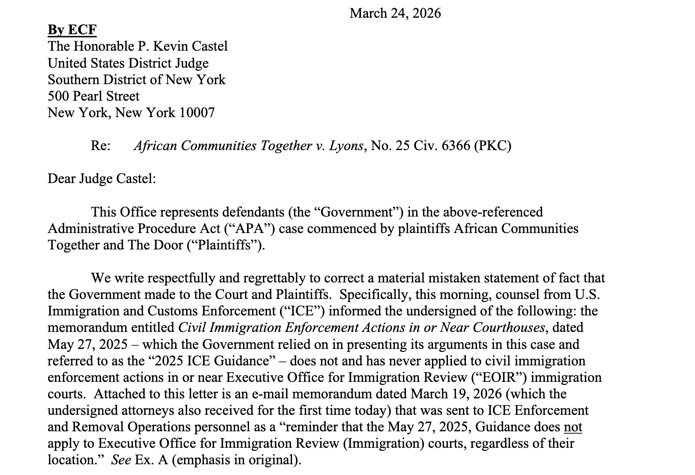
Source